

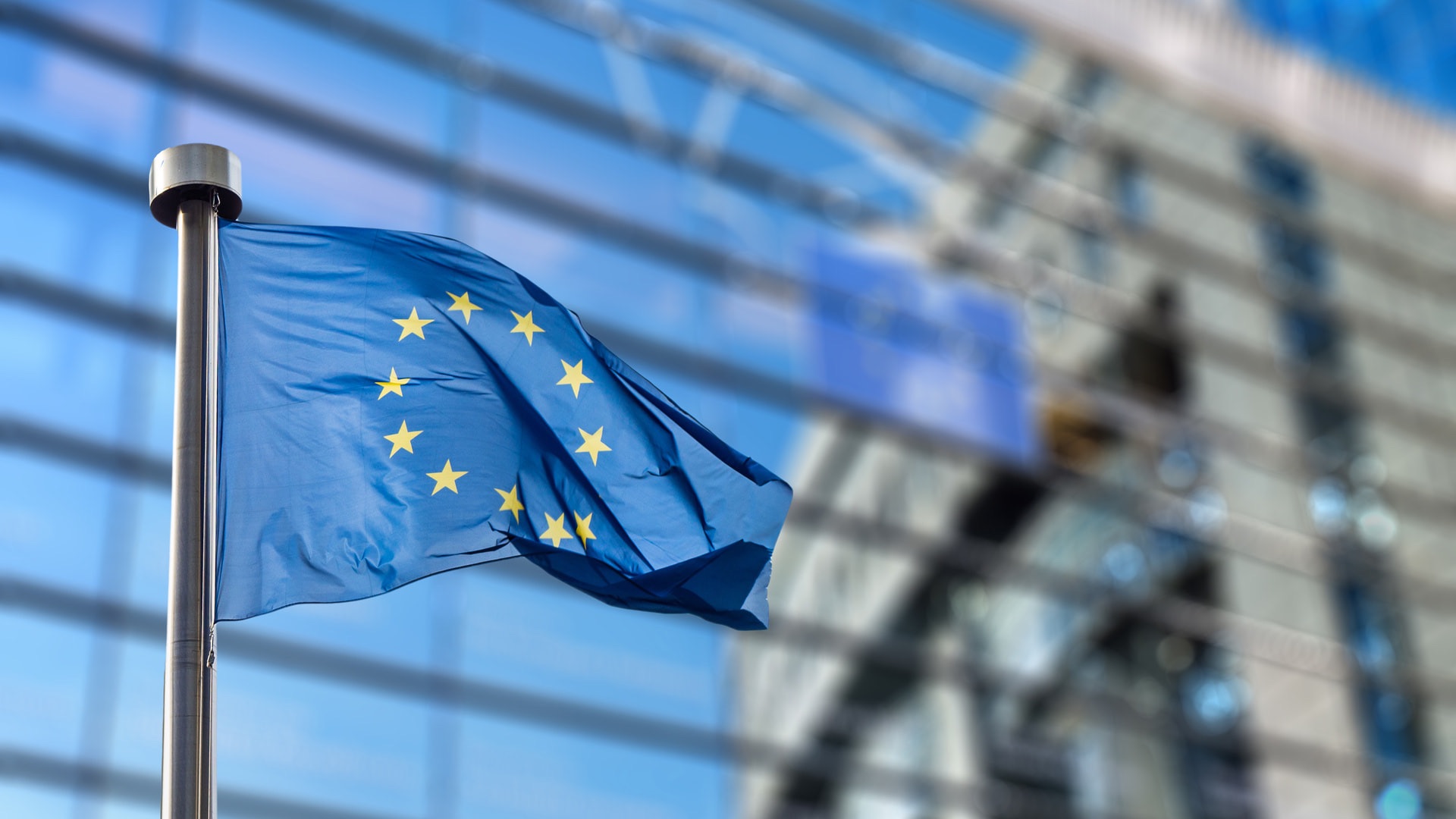
28 May 2026, the Europa building. The European ministers responsible for the internal market and industry opened their Competitiveness Council at nine-thirty, and the first public hour of proceedings was enough to read the moment: at nine-forty, an orientation debate on the Industrial Accelerator Act, the text that aims to bring the share of manufacturing industry to 20% of Union GDP; at eleven-ten, a ministerial alliance meeting on energy-intensive industries, under the programmatic title “tackling the risks of circumstances to strengthen Europe’s strategic industries”; at eleven-twenty, an information point tabled by five member states, Bulgaria, the Czech Republic, Greece, Poland and Romania, on a subject whose very title deserves a pause: “the impact of the EU ETS on energy-intensive industries.” Three agenda items, one morning, and between them a tension that no longer needs to be named to be felt, the tension running through all of European industrial policy today, caught between the obligation to decarbonise, the urgency to protect, and the permanent temptation to ease.
A mechanism that bridges two worlds
That Brussels morning is a useful shorthand, because it gathers in one place and moment what has been playing out for years in scattered fashion. The same Council that debates how to leverage the single market “via European preference and low-carbon requirements,” to use the agenda’s own phrasing, then listens to five countries come and say, in substance, that the carbon market weighs too heavily on their steelworks, cement plants and chemical factories. The coherence of the European regulatory architecture is measured precisely there, in its capacity to hold together two movements that appear to contradict each other, and that is the entire stakes of the Carbon Border Adjustment Mechanism, the CBAM, which entered its definitive phase on 1 January 2026, sitting at the exact point where the two logics are supposed to reconcile.
The mechanics deserve restating, because everything else depends on them. The CBAM aims to subject products imported into the Union to a carbon price equivalent to that borne by European industrialists, with the stated goal of preventing carbon leakage and ensuring more level competitive conditions for producers on the continent. Since 1 January 2026, any importer of cement, steel, aluminium, fertilisers, hydrogen or electricity beyond fifty tonnes per year must hold the status of authorised CBAM declarant, an application to be filed before 31 March 2026 on pain of import suspension; the first certificates will go on sale in February 2027, to cover 2026 imports, and the first annual declaration will follow in September 2027. The timeline is therefore slow, almost deceptively so, and this is a first source of misunderstanding: the mechanism is in force, but its financial effects will not materialise in accounts until 2027, leaving many companies with the illusion of a reprieve.
The decisive point, the one most often forgotten when the CBAM is reduced to a “carbon tax at the border,” is that it forms a mirror system with the internal carbon market. Until now, European industrialists exposed to international competition received free emissions quotas, precisely to avoid being disadvantaged against competitors paying no carbon price. The CBAM only functions on the condition that these free quotas disappear: the elimination of free allocation for the covered sectors will therefore proceed gradually, via a “CBAM factor” that declines from 97.5% in 2026 to 51.5% in 2030, then 14% in 2033, reaching by around 2034 a fully symmetrical system where European producers and importers alike bear the full carbon price. In other words, the CBAM is not a shield added on top of existing protections, it is the instrument that is supposed to allow those protections to be removed one by one without exposing European industry to the flight of its competitors.
This is where the tool’s dual nature appears: a climate instrument because it extends the carbon price signal to imported goods and, in theory, incentivises foreign suppliers to decarbonise to remain competitive; a competitiveness instrument because it conditions the very possibility of tightening the climate constraint on European soil. The two functions are inseparable, which makes the mechanism both elegant on paper and fragile in execution, since it only takes one leg to give way for the whole structure to wobble.
The real weight: modest on the surface, concentrated in depth
One figure captures the difficulty of discussing this accurately. On the eve of its full application, the CBAM concerned only around 3% of Union imports, according to OECD economist Antoine Dechezleprêtre, who anticipated “a recomposition of European imports in favour of the most virtuous countries such as Canada, Mexico, Chile and Turkey”; an IMF study circulated at the same time put the share of total imports affected at 4.5%. Three to four per cent: at that scale, one might mistake this for a marginal device, one more customs formality on the long list of European constraints.
The reality is entirely different once you descend into sectoral detail, because that statistically modest weight concentrates in spectacular fashion. According to projections relayed by several specialist consultancies, the iron and steel sector alone is expected to account for around 81% of CBAM costs mobilised in 2026, for a total charge exceeding twelve billion euros across Europe, and for an SME consuming five hundred tonnes of imported steel per year, the expected surcharge already runs into tens of thousands of euros, before certificates even appear in the accounts. The same logic holds, to varying degrees, for aluminium, fertilisers and cement: sectors where the carbon-intensive raw material represents a determining share of the cost price, and where a few euros per tonne of CO2 translate immediately into margin compression.
The debate brought to the Council on 28 May by five member states on the impact of the ETS then makes full sense: these countries, where heavy industry carries greater weight in the national economy, are not contesting the climate objective as such, they are flagging the concentration of cost and the pace of transition. And France itself, often presented as a driver of ambition, secured as early as 10 January 2026, through the Finance Ministry, a temporary suspension of the CBAM on imported fertilisers, a clear illustration that the trade-off between climate and competitiveness is never settled once and for all at Union level, but renegotiated sector by sector, capital by capital, according to each country’s structural dependencies.
A coherent architecture, but still unfinished
On paper, Europe has built an edifice of remarkable coherence. The CBAM closes the border to cheap carbon; the progressive elimination of free quotas restores the price signal internally; the Industrial Accelerator Act, presented in March 2026, adds a third layer by introducing European content and low-carbon performance criteria into public procurement and aid schemes, with the objective of lifting manufacturing industry from 14.3% of GDP in 2024 to 20% in 2035. The overall logic is legible: protect the border, restore the truth of prices in the internal market, and orient public demand toward decarbonised products manufactured on the continent. Each piece is meant to reinforce the others.
But the edifice is not yet stable, and the chronology of summer 2026 will reveal as much. The Commission has announced a climate package for the second half of the year, including a revision of the EU ETS expected as early as July, which must in particular re-examine the benchmarks, that is, the reference values used to calculate emissions. But the definitive benchmarks for the CBAM itself will only be available after this revision: until the internal carbon market has been recalibrated, the border mechanism will operate on still-provisional values. The architecture is therefore coherent in principle, unfinished in its parameters, and every affected economic actor must today take long-term investment decisions on the basis of a framework whose precise settings will only be fixed along the way.
To this parametric uncertainty is added a political condition that European officials now articulate without circumlocution. German Economy Minister Katherina Reiche stated that it was “absolutely clear” that the CBAM must function effectively before the free certificates for the most energy-intensive companies can be eliminated. The formula deserves to be weighed: it subordinates the climate calendar, the end of free quotas, to prior proof of CBAM effectiveness. It is a guarantee of prudence for industry, and at the same time a fault line in the mechanism, since it introduces a possible reversibility precisely where industrialists expect stability instead.
The technical fault and the credibility wager
The most delicate link in the device deserves a pause, the one that determines whether it will fulfil its climate function or not. The CBAM rests on default values applied to imports whose real emissions are not declared, values that are supposed to be sufficiently penalising to push foreign suppliers to measure and declare their actual footprint, and to reduce it. The paradox has been well identified by sector observers: the more penalising these values, the more they incentivise declaration, but the more they also push importers to shift toward “certified low-carbon” suppliers whose figures are not always verifiable. The mechanism only holds if all actors play the declaration game honestly, a condition all the harder to guarantee given that measurement, traceability and verification systems differ profoundly from one exporting country to another.
Added to this is the risk of resource shuffling, the flow rearrangement by which a producer reserves its least carbon-intensive output for the European market while continuing to sell the rest elsewhere, without changing its global emissions at all. Citepa, through the voice of its expert Adelaïde Tresarrieu, notes that while part of industry considers the mechanism will restore more equitable competitive conditions, certain sectors, particularly steelmaking, remain attentive to its implementation modalities and its effects on value chains, with resource shuffling explicitly listed among the subjects of vigilance. The CBAM’s climate function is therefore not secured by its mere existence: it depends on the quality of its implementation, the robustness of its controls, and the stability of the price signal it transmits.
This is where the European wager is tied, and it is worth stating it plainly. The Union has chosen a long sequence, nine years of build-up between 2026 and 2034, during which it asks its industrialists to commit heavy decarbonisation investments, to be amortised over fifteen or twenty years, by betting that the carbon constraint will remain sufficiently credible and sufficiently stable to make those investments profitable. The calculation of the industrialist who today decides to replace a fossil process with an electrified or hydrogen-based one rests entirely on an anticipation: that the carbon price will hold, that free quotas will disappear as announced, that the CBAM will hold at the border, and that no political revision will come to loosen the vice at precisely the moment when transition costs the most. Yet industrialists have memory of past deferrals, they observe that benchmarks are not fixed, they hear ministers conditioning the end of free quotas on proof of the mechanism’s effectiveness, and they know that five member states came, on 28 May, to put the ETS question back on the Council table.
What is at stake for those who have already invested
For companies that anticipated, that committed capital to low-carbon processes before the definitive entry into force, the current situation presents an uncomfortable asymmetry. They bore the cost of transition first, betting on a regulatory framework that would reward their head start, and their return on investment now depends on a mechanism whose definitive parameters they do not control, and whose political trajectory remains open. If the CBAM holds, if the price signal strengthens as planned, their lead converts into a durable competitive advantage, with competitors importing cheap carbon progressively paying the price of their delay. If the mechanism proves porous, susceptible to resource shuffling or weakened by successive revisions, then these same companies will have paid alone for a transition that the market will not reward, while those who waited will have been right to defer.
The device therefore creates a premium on the wager, and that premium cuts both ways: it rewards those who believed in the stability of the constraint, provided that stability is confirmed, and punishes that same belief if it proves naive. This is a profoundly unusual situation in industrial policy, where the more common practice is to secure investment through direct subsidy or guaranteed offtake; here, the principal incentive lies in the promise of a future constraint, and the value of that promise depends on the constancy of whoever makes it. The Commission knows this, multiplying guarantees of robustness and anti-circumvention measures, but it also knows it is moving along a ridge line, between a constraint strong enough to trigger investment and supportable enough not to push industries to relocate before the mechanism can even protect them.
The morning of 28 May said exactly this, in the sobriety of an agenda. A Union that now openly assumes the protection of its industry, inscribing European preference and low-carbon requirements at the heart of its doctrine, while in the same breath listening to its own members express concern about the weight of the constraint it has itself erected. The CBAM sits at the centre of this balance, because it is the only instrument that claims to reconcile both demands, and that is why its fate, in the summer revisions and in the years of build-up that follow, will be worth far more than the 3% of imports it concerns today: it will say whether Europe is capable of sustaining over time a constraint it imposes on itself before imposing it on others, and whether the wager it asks its industrialists to make was an act of lucidity or of faith.